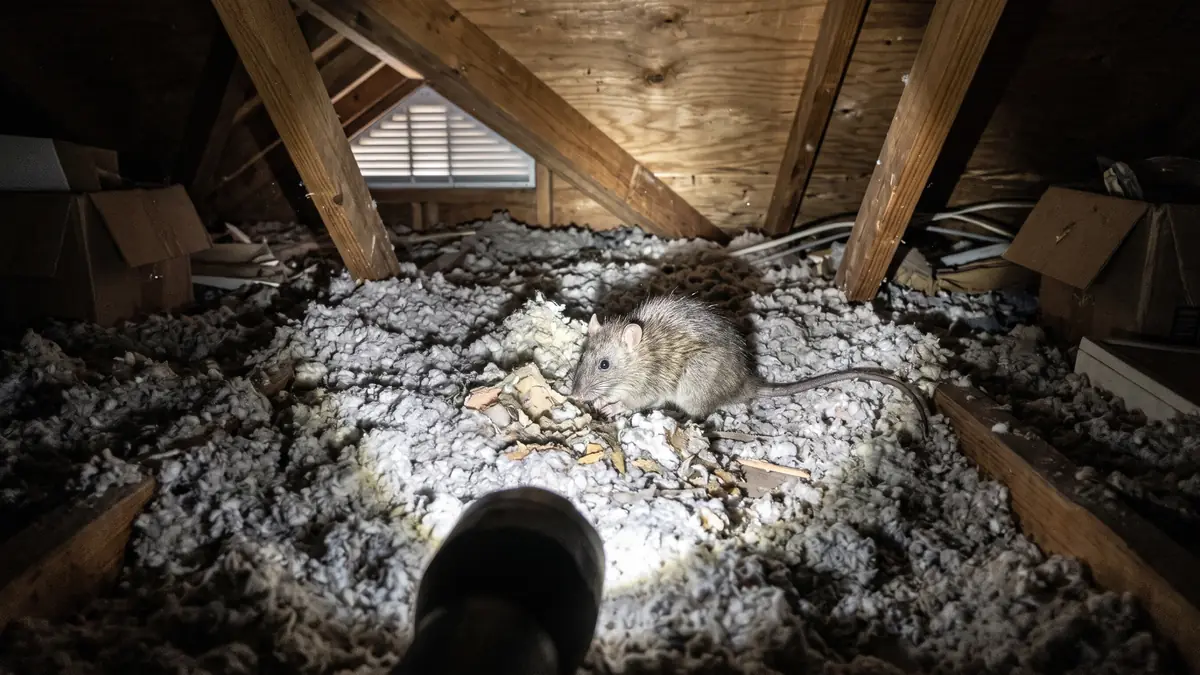
Rat and mouse calls are the most common reason Katy, TX homeowners reach for a pest pro once the nights cool off. Houston has the data to back that up: Terminix's State of the Rodent report ranked the Houston area 7th in the country for rat calls in November 2025, and Orkin's October 2026 list moved Houston up nine places to No. 14 on its rattiest cities ranking, based on new residential rodent treatments.
Katy's housing stock makes the pattern sharper. Two-story slab homes with brick wainscot, hip roofs and crape myrtles planted close to the eaves give roof rats an easy climb, and the attic over the garage is where most of them end up.
Roof rat, Norway rat or house mouse: who is in the house
A roof rat in the attic and a Norway rat under the slab need two different plans, and a house mouse fits through gaps neither rat could use.
| Trait | Roof rat | Norway rat | House mouse |
|---|---|---|---|
| Head and body | 7–8 in, slim | 8–10 in, heavy | Much smaller; adult fits in your palm |
| Tail | Longer than head and body (8–10 in) | Shorter than head and body (4–8 in) | About as long as the body |
| Ears and snout | Large ears, pointed snout | Small furry ears, blunt snout | Large ears for its size |
| Droppings | Pointed, about 1/4–1/2 in | Blunt ends, 3/4–1 in | Pointed, about 1/8–1/4 in |
| Where it nests | Above ground: trees, vines, attics | Burrows at ground level, under slabs and debris | Warm spots close to food: cabinets, garage storage |
| Gap it needs | Quarter-size hole or 1/2-in gap | Quarter-size hole or 1/2-in gap | Pencil-width, about 1/4 in |
| Where Katy homeowners find it | Attic over the garage, second-floor ceilings | Garage floor, along the foundation, compost | Pantry, under the dishwasher, garage shelving |
Sizes and droppings come from Maricopa County's roof rat ID sheet and Texas A&M AgriLife training material; gap sizes are from AgriLife's Rodent IPM guide and the CDC.

What rats and mice leave behind in a Katy, TX home
Roof rats are active at night, so the classic report is scratching or a "bowling ball" roll above a bedroom ceiling between midnight and dawn, usually on the garage side of the house.
Look for these signs room by room:
- Attic: runways flattened into blown-in insulation, droppings along the top plates, chewed duct wrap or wiring, and greasy rub marks where rats squeeze past rafters.
- Garage: droppings behind the water heater, gnawed corners on pet food or birdseed bags, and shredded cardboard tucked into storage bins.
- Kitchen: droppings in the drawer under the oven or behind the fridge, which more often means mice than rats.
- Outside: a worn path along the top rail of a wooden fence, fruit or pecans half-eaten under a tree, and dark smudges at a gap in the soffit.
A few droppings in one place mean recent activity, not necessarily a big colony. Shiny, moist droppings mean recent traffic; dull, crumbly ones may be months old. AgriLife notes mice alone can leave 50 to 75 droppings a day when activity is high, so counts climb fast.
Rat & mouse season meter
- JJanuary: peak
- FFebruary: peak
- MMarch: rising
- AApril: low
- MMay: low
- JJune: low
- JJuly: low
- AAugust: low
- SSeptember: rising
- OOctober: peak
- NNovember: peak
- DDecember: peak
Indoor pressure climbs as fall nights cool and peaks through winter.
Roof rat signs
Noises in the attic after dark, droppings pointed at both ends on insulation, greasy rub marks along rafters, runs along fence tops and power lines.
Norway rat signs
Burrows under slabs, sheds and dense shrubs, blunt droppings in the garage, gnawed bags on low shelves.
How rodent control in Katy, TX actually gets done
A proper visit starts in the attic and on a ladder, not with a box of bait. The pro you're connected with should walk the roofline, open the attic, check the garage and follow runways back to the gaps the animals use. Expect them to name each entry point, photograph it and tell you whether it is a rat-sized or mouse-sized opening.
Six entry points on two-story slab homes
These are the gaps that show up again and again on Katy-style builds from the 1990s through today. The CDC's own sealing checklist names the same zones: roof rafters, gables, eaves and soffits, vents and utility line openings.
- Roof returns and eave gaps. Where a first-floor roof meets the second-story wall, builders leave a small open pocket behind the fascia. It is a favorite roof rat door on these houses, and it opens straight into the attic over the garage.
- Garage door corners. The rubber seal wears and the bottom corners of the door frame gap open against the brick. A half-inch gap is enough for a rat.
- Weep holes in the brick. The open joints along the bottom course of brick drain moisture and must stay open, but they admit mice. Stainless mesh weep screens close them without blocking drainage. Never fill them with mortar or foam.
- AC line penetrations. The copper line set and condensate line enter through an oversized hole that is often packed with nothing but a little foam, which rats chew through in a night.
- Dryer vents. A missing or broken flap on the exterior vent hood gives mice a warm, lint-lined tunnel into the laundry room wall.
- Gable vents and plumbing stacks. Torn screens behind gable louvers, and the gap around roof plumbing boots, are the high-level entries roof rats reach from overhanging branches.
Trapping vs exclusion
Trapping and exclusion do two different jobs, and you need both. Traps remove the animals already inside. Exclusion stops replacements from the fence lines, trees and neighbors' yards around you.
Trapping inside an attic usually means snap traps set along runways and checked on a schedule, often two to three visits over one to three weeks. AgriLife recommends pre-baiting rat traps unset for a period so wary rats get used to them, and placing many traps rather than a few.
Exclusion means sealing every entry with materials rats cannot chew: galvanized hardware cloth, sheet metal, copper or stainless mesh, and sealant over it. Expanding foam on its own is not a rat repair. Exclusion should come after trap counts fall, or be paired with one-way doors so animals can leave but not return.
Bait stations belong outside, locked and anchored, if they are used at all. Poisoned rats often die inside wall voids, and the odor in a Katy summer is hard to live with.
Trapping and baiting for rats counts as regulated pest work in Texas, so the business needs a state structural pest control license. Search its name on the Texas Department of Agriculture's license database before anyone climbs into your attic.
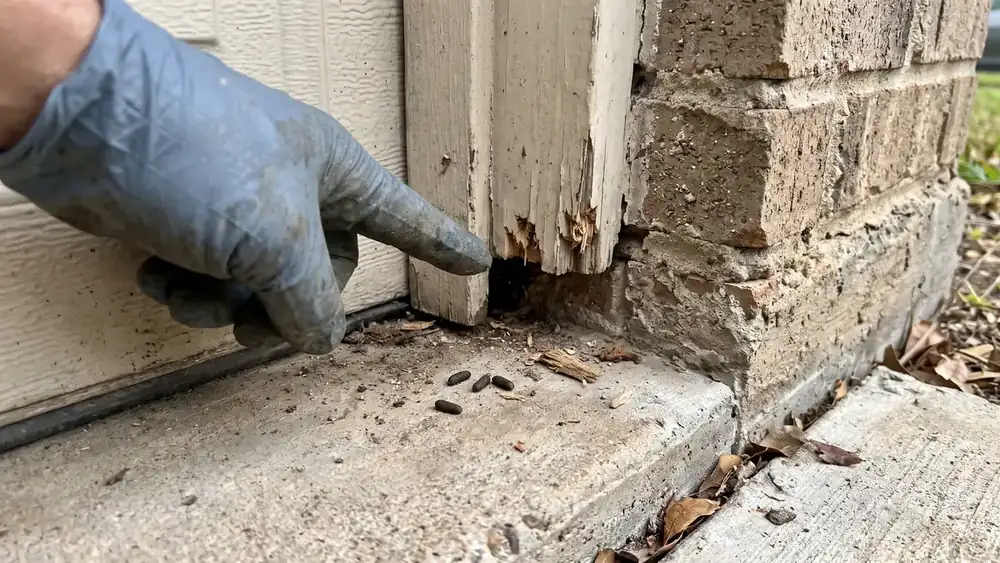
Rat removal and exclusion cost in the Houston area
Treat the figures below as published Houston-area ranges rather than a quote. Your number depends on how many entry points need sealing, roof height and pitch, and how much of the attic is contaminated.
- Inspection: $75–$150 nationally per HomeGuide; Angi lists $220–$430 for Houston, and some companies credit it toward the job.
- Trapping and removal: most Houston homeowners pay $381–$1,370, averaging about $831, per Angi's Houston figures.
- Exclusion (sealing entry points): $430–$1,300 in Houston per Angi; HomeGuide shows $500–$1,500 for multiple entries sealed over up to four visits.
- Full plan with exclusion doors and a month or more of monitoring: $600–$1,400 (HomeGuide).
- Attic cleanup and sanitizing: $600–$1,000 (HomeGuide), more if insulation is replaced.
A second-story roofline usually costs more than a single-story job because of ladder work and steeper pitch.
After the job: keeping the roofline closed
Once the attic is quiet, the goal is to make your house less attractive than the one next door. Trim branches and crape myrtle limbs back so nothing touches or hangs within a jump of the roof. Keep ivy and fig vine off the brick.
Store pet food, birdseed and grass seed in lidded metal or heavy plastic bins, not bags. Pick up fallen pecans, citrus and loquats, which roof rats feed on heavily in fall. Move firewood and stacked lumber off the slab edge.
Walk the roofline from the ground twice a year and look at each sealed point. Roofers, satellite installers and AC techs are the usual reason a sealed gap reopens.
Health basics from the CDC
The CDC says rodents can spread disease directly through their droppings, urine, saliva and bites, or when people breathe in dust contaminated by droppings and urine. They can also carry fleas, ticks and mites that spread disease. That is why cleanup should not be dry sweeping or vacuuming of droppings; read the CDC's rodent control pages before you handle any of it yourself.
When rodent pressure climbs in Katy, TX
Rats and mice live outside year-round here, but indoor calls rise as fall nights cool and food outside gets scarce. Per AgriLife, Norway rats breed hardest in spring and again in fall, so autumn brings both cooler nights and more young rats looking for a home.
Rats & mice indoors by month around Katy, TX
| Pest | Jan | Feb | Mar | Apr | May | Jun | Jul | Aug | Sep | Oct | Nov | Dec |
|---|---|---|---|---|---|---|---|---|---|---|---|---|
| Rats & mice indoors | peak | peak | active | low | low | low | low | low | active | peak | peak | peak |
low active peak
Pressure rises as nights cool in fall.
For the longer story on why fast-built subdivisions and older roofs both draw rats, read our guide to rats in Katy homes.
Rat and mouse calls across the Katy area
Every part of the ring has its own version of the problem. The 20- to 30-year-old two-story homes around Cinco Ranch's master-planned sections see roof rats in aging attics, while the 1970s–90s houses on the older east side of Katy add tired fences and worn roof edges to the mix.
New construction is not exempt. Land clearing on the west side pushes rodents into the first homes built nearby, which is why new builds around Fulshear can see mice in garages soon after move-in. Out past the county line, Brookshire's rural homes and barns deal with rats around feed, hay and outbuildings.
Before you call about rats or mice
Have these details handy so the pro can tell you on the phone what kind of visit you need.
Before you call
- Where you hear or see activity: attic over the garage, bedroom ceiling, kitchen, or garage floor
- What the droppings look like: rice-grain size points to mice, raisin size or bigger points to rats
- Your ZIP and whether the home is one or two stories
- Roughly when the home was built, and whether a builder or roofer has worked on the roofline since
- Kids, cats or dogs in the house, so the pro plans trap and bait placement around them
- Owner or renter, and if renting, whether the landlord has approved sealing work
- Any trees, vines or fences touching the roof or within a jump of it
Questions about rodent control
How hard is it to get rid of a rat infestation?
A rat problem is very solvable in a typical Katy, TX house, but it is not a one-visit job. Trapping the rats already inside usually takes one to three weeks of checks, because rats are wary of new objects and need time to approach traps. The hard part is the sealing: if one roof return or AC line gap stays open, new rats replace the ones you caught. Plan on trapping, exclusion and a final check before you call it done.
What does pest control for rats cost?
Angi puts the typical Houston-area rat job at $381 to $1,370, with an average of about $831. That figure usually covers inspection and trapping. Sealing entry points is often quoted separately, at roughly $430 to $1,300 in Houston per Angi, and attic cleanup of droppings and nesting runs $600 to $1,000 by HomeGuide's national figures. Ask whether the inspection fee is credited back if you hire the company.
What is the most effective rodent control?
The most effective approach is exclusion backed by trapping. The CDC's own advice is to seal holes, trap the rodents inside and clean up safely, in that combination. Traps remove the current animals; sealing gaps of a quarter inch and larger stops the next ones. Poison alone tends to leave rats dying inside walls and does nothing about how they got in.
Are roof rats or Norway rats more common in Katy, TX homes?
In attics, roof rats are the usual culprit. They nest above ground in trees, vines and dense shrubs, then travel along fences, power lines and branches to the roof. Norway rats are burrowers that stay at ground level, so they show up under slabs, in woodpiles and along foundations. The droppings tell you which one you have: pointed and about half an inch for roof rats, blunt and closer to an inch for Norway rats.
Can I just seal the holes myself and skip trapping?
Sealing first is the one order you should avoid. Rats trapped inside a sealed attic will chew new exits, often through soffit or drywall, and some die in places you cannot reach. Seal after the trap counts drop to zero, or have the pro install one-way doors at the main entry so animals leave before the last gap is closed.
Do I need to replace attic insulation after rats?
Not always, but heavy contamination usually means at least partial removal. A pro will look at how far the droppings and urine staining spread from the main runways. Light activity along one side of the attic can often be cleaned and treated in place; insulation that is matted, tunneled or soaked near nesting sites is normally bagged and replaced.
How fast do mice multiply in a Katy house?
Fast enough that a few mice in October can be a real problem by January. House mice nest close to food and stay within about 20 feet of the nest, so a pantry, a garage freezer or a bag of dog food can support a whole family. Texas A&M AgriLife notes one breeding pair can become an infestation quickly, which is why a single sighting is worth a call.
Sources
- Terminix via FOX 26 Houston: Houston ranked 7th in U.S. for rats (Nov 19, 2025)
- Orkin: Los Angeles holds No. 1 spot on 2026 Rattiest Cities list (Houston No. 14, Oct 13, 2026)
- CDC: Controlling Wild Rodent Infestations
- CDC: How to Seal Up (rodent entry points, 1/4-inch gaps)
- Maricopa County: Roof Rat Identification (roof rat vs Norway rat sizes and droppings)
- Texas A&M AgriLife Extension: Rodent IPM (entry gap sizes, home range, trapping)
- Texas A&M AgriLife Extension: Rodents and rodent control, public health course (mouse droppings, seasonality)
- Angi: Rat exterminator cost in Houston, TX
- HomeGuide: Rodent removal cost
- Texas Department of Agriculture: Structural Pest Control (license lookup)