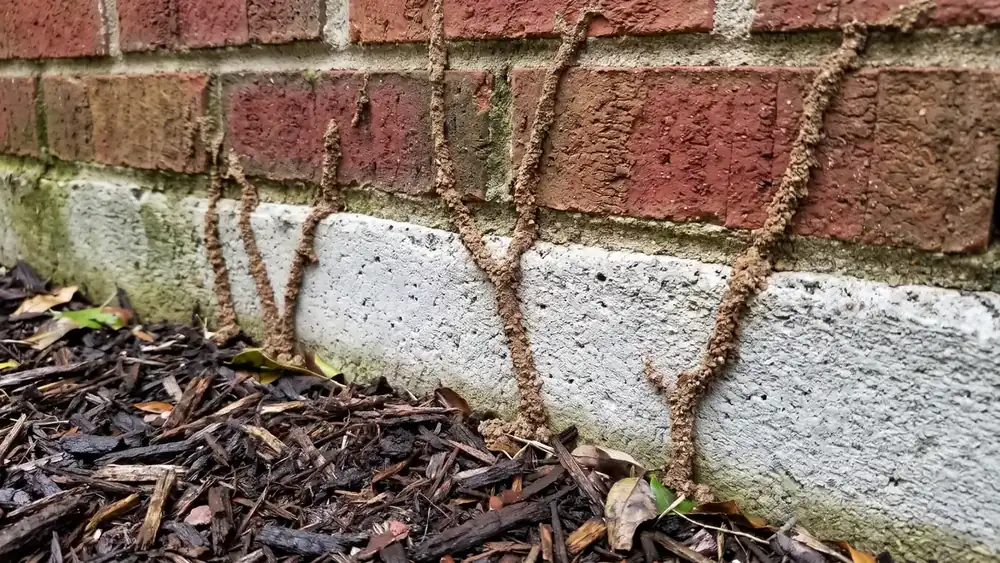
Termites rarely announce themselves in a Katy, TX house. Brick veneer over a slab hides most of the action, so the first clue tends to be something small: a pile of wings on a windowsill, a thin mud line on the foundation, or a baseboard that dents when the vacuum bumps it.
What termite trouble looks like on a Katy slab home
These are the finds that send homeowners to the phone, roughly in the order people notice them:
- Shed wings. Small, equal-length wings piled on a sill, in a light fixture or on the doormat after a warm, humid evening. Swarmers inside the house usually mean the colony is in the structure, not just the yard.
- Mud tubes. Pencil-width tunnels of soil running up the slab edge onto the brick, along a plumbing penetration, or up the inside of a garage wall. Break one open; if it is rebuilt in a few days, it is active.
- Damaged trim. Door frames, baseboards or window sills that sound hollow when tapped, or paint that bubbles where termites have eaten right up to the surface.
- Mud in odd places. Soil packed into drywall nail holes or cracks in a garage slab.
A crape myrtle bed or flower border piled up against the brick hides the slab edge, which is exactly where tubes start. If you cannot see two to four inches of bare foundation, you cannot see the warning signs either.
Formosan or native: what your find means
Most of the Katy area sits in two counties on Texas A&M's Formosan termite list: Harris and Fort Bend. Waller County and Austin County are not on it, so homes out toward Brookshire, Prairie View and Sealy are dealing with native subterranean termites only.
| Trait | Formosan subterranean | Native subterranean |
|---|---|---|
| Counties in the Katy area | Harris, Fort Bend (confirmed) | Harris, Fort Bend, Waller, Austin |
| Swarm timing | Late May to early June, at night, around lights | Earlier in the year; can start January–February in South Texas |
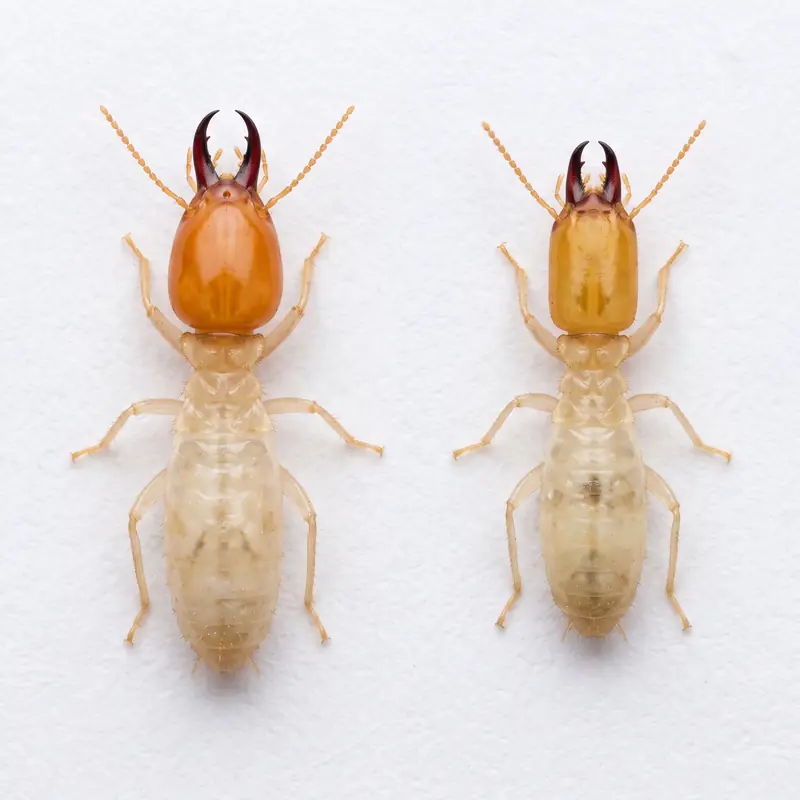
| Swarmer look | Yellowish brown, about 1/2 to 5/8 in (12–15 mm) | Usually dark, about 1/4 to 3/8 in |
| Soldier head | Teardrop or egg shaped; may ooze white defensive fluid | More rectangular |
| Colony size | Can exceed 1 million termites | Far smaller |
| Above-ground nests | Often builds "carton" nests inside walls | Rarely; stays tied to the soil |
| What it means for treatment | Faster damage; inspect walls, not just the slab edge | Standard slab and perimeter focus |
Facts from Texas A&M AgriLife's Formosan and native subterranean termite pages.
Termite control in Katy, TX: liquid barrier or baits
Both methods are proven on Gulf Coast slab homes. The choice comes down to how active the infestation is, what is poured around the house, and how you feel about yearly monitoring.
Liquid termiticide
The pro trenches the soil along the foundation and drills through patios, sidewalks and the garage apron so the product reaches soil under the concrete. Modern non-repellent products kill termites that tunnel through the treated zone, usually within a few days. Texas A&M's subterranean termite guide puts protection at roughly five years.
Bait stations
Stations go in the ground every few feet around the house. Termites feed on the bait and carry it back, which can wipe out the colony itself. The trade-off is time: AgriLife says control can take several months to more than a year, and baits give no residual protection once stations are pulled.
Inspections and WDI reports for a sale
For a formal termite inspection or treatment, Texas law requires a Wood Destroying Insect report and a sticker posted under the kitchen sink, on the electrical box or on the water heater with the company, date and result. When the inspection is for a home sale, it must be written on the state's official WDI form and issued by a licensed business. A TREC home inspector license alone does not cover it.
Every termite company working in Katy needs a state license from TDA's Structural Pest Control Service. Look up a termite company's TDA license before you sign a contract.
What termite treatment costs around Houston
These are typical published ranges for 2025–2026, not quotes.
- Termite inspection: $100–$200 in Houston per Angi; yearly re-inspections run $75–$150 in Texas per Fixr.
- Typical treatment: $223–$838, averaging about $515 in Houston (Angi).
- Liquid barrier: about $3–$14 per linear foot of foundation (Angi).
- Bait system: about $6–$11 per linear foot to install (Angi), plus monitoring contracts of $230–$540 a year in Texas (Fixr).
- Large infestation: $1,200–$2,400 (Angi).
Two-story Katy homes often have a bigger perimeter than their square footage suggests, thanks to bump-outs, a three-car garage and wraparound patios. Ask the pro to quote by linear foot and list which slabs they will drill.
Swarm months on the Gulf Coast
Native swarmers can show up as early as late winter, while Formosan flights peak on warm nights in late May and early June. If you see either inside, collect a few in a zip bag for the inspection. For the full timeline and how to tell swarmers from flying ants, see our Houston termite swarm season guide.
Termite swarms by month around Katy, TX
| Pest | Jan | Feb | Mar | Apr | May | Jun | Jul | Aug | Sep | Oct | Nov | Dec |
|---|---|---|---|---|---|---|---|---|---|---|---|---|
| Termite swarms | quiet | low | active | peak | peak | active | low | quiet | quiet | quiet | quiet | quiet |
low active peak
Native swarms on warm days after rain; Formosan swarms on spring evenings.
Making a slab house harder for termites to reach
- Rake mulch back so a band of bare slab shows above it and the brick weep line stays clear.
- Fix sprinkler heads that spray the foundation, and keep gutters draining away from the house.
- Pull firewood, landscape timbers and old fence posts away from the slab.
- Prune shrubs so you can see the foundation all the way around.
- Keep your treatment or bait contract active after a sale; the WDI sticker under the sink shows the next inspector what was done.
Termite calls from Rosenberg to Brookshire
Older housing raises the stakes. Downtown Rosenberg homes near the rail lines and Richmond streets along the Brazos include older houses where a past treatment may have long since lapsed, while the 1970s–90s slabs of east Katy's established subdivisions can have patios and additions poured after the original treatment.
West of the county line, Brookshire-area homes in Waller County fall outside the Formosan list, so treatment plans there focus on native subterranean colonies.
Before you call about termites
Before you call
- What you found: winged swarmers, shed wings, mud tubes, or soft and hollow wood
- Where: which wall, room or slab edge, and whether it is inside or outside
- If you saw swarmers, the month and whether it was day or night near a light
- Your ZIP, so the pro knows whether Formosan termites are part of the picture
- Any past treatment, bait stations in the yard, or a builder pre-treat warranty
- Whether you need a Texas WDI report for a sale or refinance, and the closing date
Questions about termite control
How much does termite treatment cost in Texas?
Most Houston-area homeowners pay $223 to $838 for termite treatment, and Angi's Houston average is about $515. Liquid barriers are priced per linear foot of foundation, roughly $3 to $14, so a large two-story footprint costs more than a starter home. Bait systems run about $6 to $11 per linear foot to install, plus a monitoring contract that Fixr puts at $230 to $540 a year in Texas.
Can termites ever be gone for good from a Katy, TX house?
The colony feeding on your house can be wiped out, but you cannot make the soil around it termite-free for good. Subterranean termites live in the ground across the whole Katy area, so protection is about keeping a treated zone or active bait stations between them and the slab. Liquid barriers last about five years by Texas A&M's estimate, which is why annual inspections matter.
Do I need a termite inspection to sell a house in Texas?
Not every Texas sale needs one, though VA loans typically do and plenty of Katy buyers request it anyway. When a termite inspection is done for a real estate transaction, the report must be on the Texas Department of Agriculture's official Wood Destroying Insect form and issued by a TDA-licensed pest control business. A general home inspector's license does not cover it.
Are Formosan termites in Katy, TX?
Yes, Formosan termites are confirmed in both Harris and Fort Bend counties, which together cover most Katy addresses. Texas A&M's county list does not include Waller County, so homes on the Brookshire and Prairie View side are dealing with native subterranean termites. Formosan swarms happen at night in late May and early June, often around porch lights.
Is a liquid treatment or bait system better for a slab home?
Neither wins every time; it depends on the house. Liquid treatment protects faster and is often the pick when termites are already inside a wall. Baits involve less drilling through patios and driveways but can take several months to more than a year to knock out a colony. Many Katy homeowners with an active infestation get a liquid barrier and keep the house on an annual inspection.
Sources
- Texas A&M AgriLife Urban Entomology: Formosan subterranean termite (Texas county list, swarm timing)
- Texas A&M AgriLife Urban Entomology: Native subterranean termites
- Texas A&M AgriLife Extension: Subterranean Termites (E-368)
- Angi: Termite treatment cost in Houston, TX
- Fixr: Termite treatment cost in Texas (updated Jan 31, 2025)
- 4 Tex. Admin. Code § 7.176: Real estate transaction inspection reports
- Spectora: Texas WDI reports, what TREC and TDA require
- Texas Department of Agriculture: Structural Pest Control (license lookup)